
The public plan for O’Hare
Fund Regional Rail 1.0.
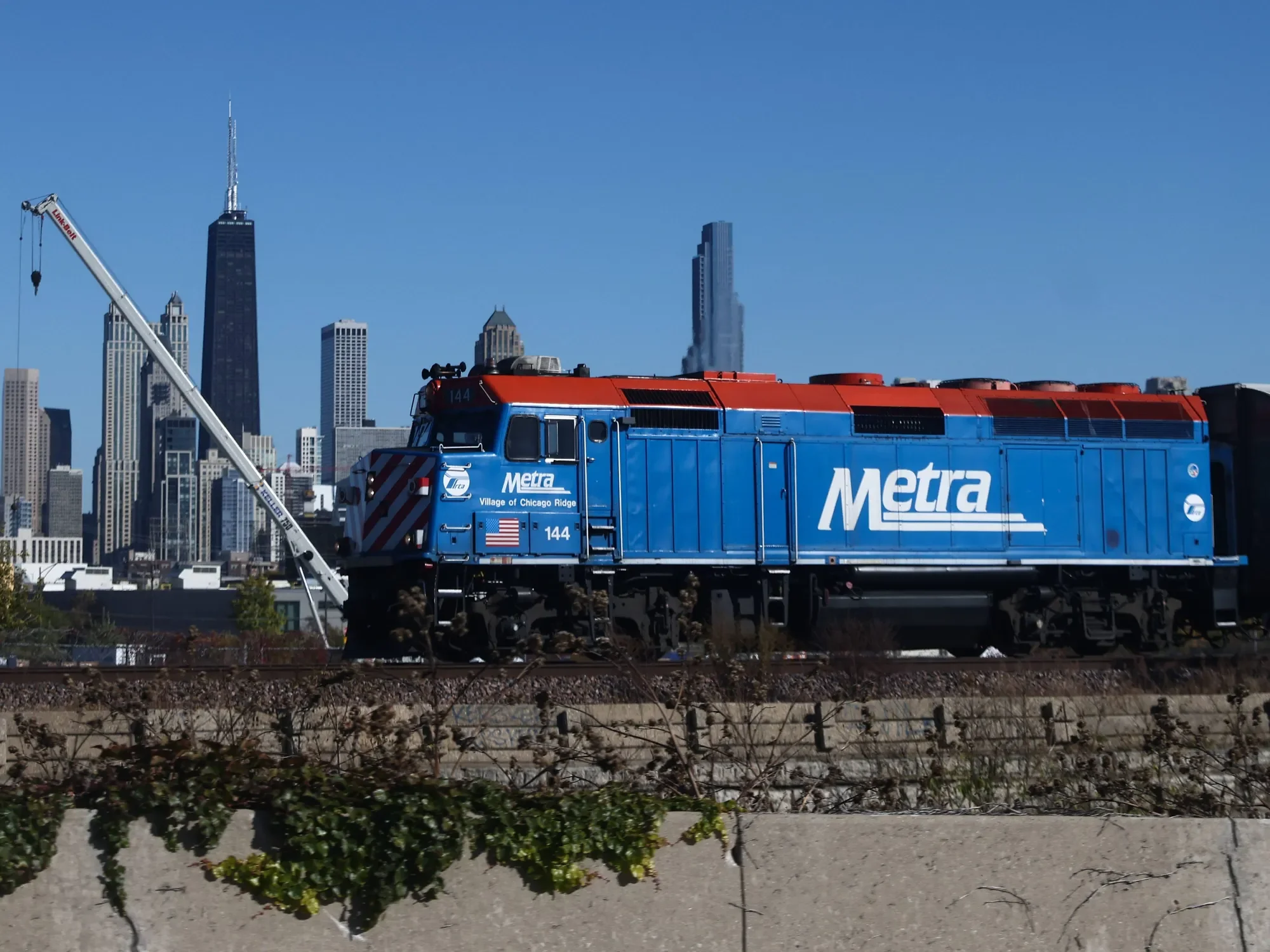
Metra, a public agency, already runs trains to O’Hare. Its draft plan would run them every 30 minutes, all day, from Union Station. All it needs now is funding.
- 30 minbetween trains to O’Hare, all day, every day
- $100Mto build, by Metra’s estimate
- 0new trains needed
What you can do
Fund Regional Rail 1.0
Metra’s plan for frequent service to O’Hare is open for public comment now. Tell Metra, and the regional transit board that funds it, to make it a priority.
1Comment to MetraTell Metra to fund Regional Rail 1.0.
Metra’s feedback form on its draft plan takes about two minutes. Copy the comment below and paste it in.
Comment to Metra → The comment to pasteFund Regional Rail 1.0, with expanded service to O’Hare every 30 minutes from Union Station. Frequent public transit to O’Hare should come from Metra and the CTA, on the lines our communities already use, and it should be a top priority.
Add one sentence about you, if you like: where you live, how you ride. Then your name and town or neighborhood.
Already filled out the survey? Send more comments anytime through Metra’s contact form.
2Comment to NITATell the NITA Board to make it a priority.
NITA, the Northern Illinois Transit Authority, funds Metra, the CTA and Pace. Its capital program is where Regional Rail 1.0 gets funded. Send a comment before its board meeting on Thursday, Nov. 19.
Email your comment to NITA →Opens your email with a comment written; add your name and community. Comments must arrive by noon the day before a board meeting: noon on Nov. 18 for the Nov. 19 meeting, or noon on Dec. 16 for Dec. 17. To speak at the meeting instead, email the same address by the same deadline and ask to speak. NITA posts comments on its website, so include only what you’re comfortable sharing publicly. See both meetings
3Join Metra’s virtual public meetingMonday, Nov. 16, 7 p.m., on Zoom
Metra will post the Zoom link at metra.com/snp by Friday, Nov. 13. We’ll share it on our events page and by email.
What Metra proposes
- Metra already runs trains to O’Hare. Its North Central Service goes from Union Station to Franklin Park on the Milwaukee District West tracks, then north to O’Hare Transfer, where riders take the airport people mover.
- Every 30 minutes, all day. In Metra’s words: “Expanded O’Hare service will be introduced to provide frequent service to Union Station. This 30-minute service will be supplemented by hourly service on the rest of the corridor.”
- About $100 million to build, for turning tracks at O’Hare Transfer and all the signal work, and about $18 million a year more to run. No new trains needed.
- Part of a regional plan. Regional Rail 1.0 would bring trains every 30 to 60 minutes on most Metra lines, about $2.7 billion across the system.
- What riders asked for. In Metra’s rider survey, people said they want trains every 30 minutes, including to the airport.
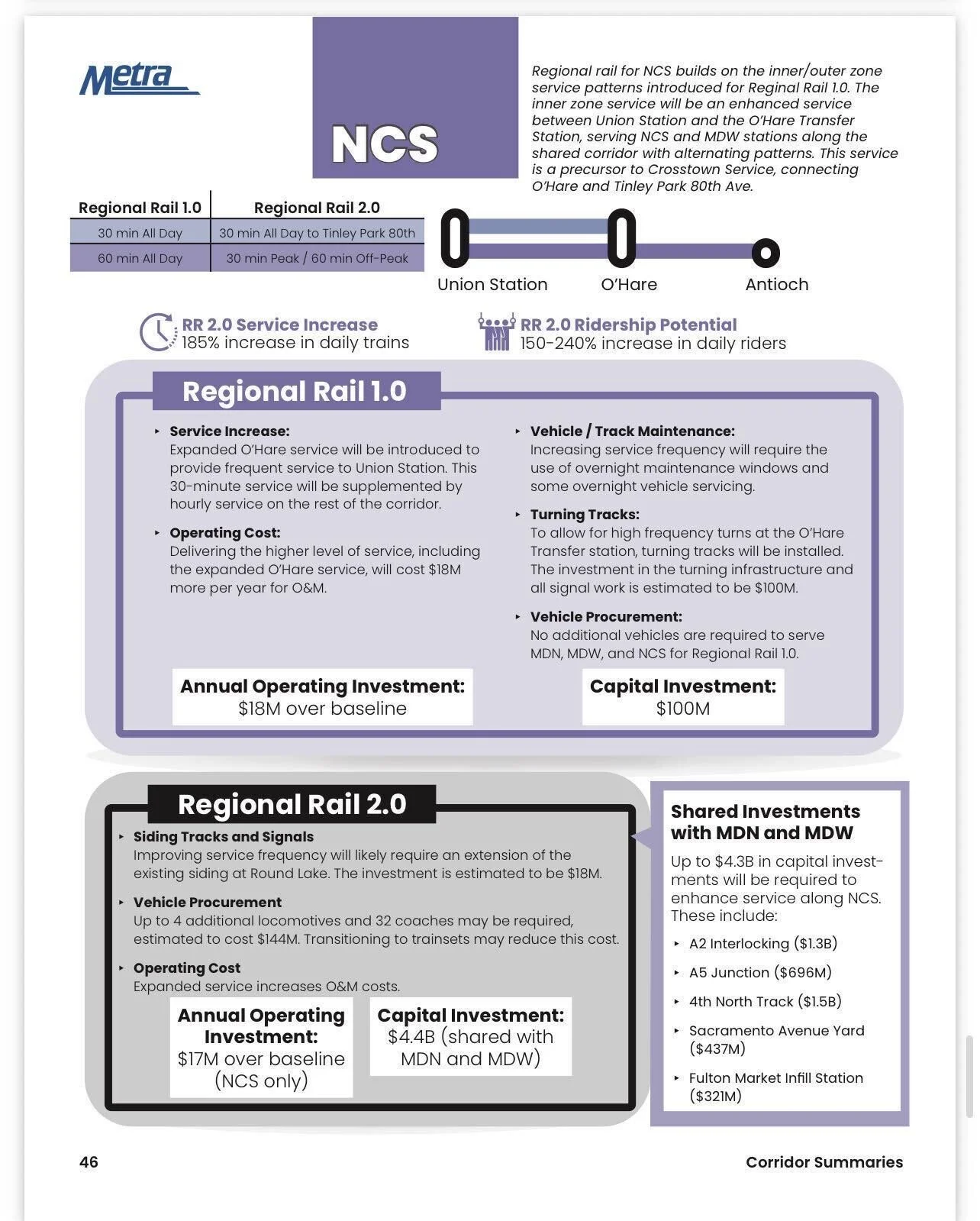
The second phase, Regional Rail 2.0, would bring trains every 15 to 30 minutes and a Crosstown Service through Union Station to the South Side, from O’Hare to Tinley Park. On the O’Hare line, Metra projects 185 percent more daily trains and 150 to 240 percent more daily riders. That takes long-term investment, about $6.4 billion across the system. Regional Rail 1.0 is the step that can come first.
The plan is a draft and sets no dates. Costs are Metra’s estimates, in 2025 dollars.
What threatens it
A private venture, the O’Hare Flyer, is asking for public support for its own O’Hare line through eleven communities and a forest preserve. It is competing for the same public support, from the same officials, that Metra’s expansion needs. Public transit to O’Hare should come from Metra and the CTA.
The same trip
The Flyer would start at the Old Post Office, a block south of Union Station. Metra’s O’Hare service starts at Union Station. Both end at O’Hare. The Flyer would duplicate a public service that already exists and that Metra has a plan to run every 30 minutes.
The same track
North of Franklin Park, the Flyer’s sponsors say they hope to lease one of Canadian National’s existing tracks, on the corridor that already carries Metra’s O’Hare trains and freight, and they have described wanting “100% end-to-end control” of their line. That corridor is the one Metra’s plan depends on. A track leased to a private airport line is a track Metra cannot run its trains on.
The same riders
The riders a private line such as the O'Hare Flyer needs to pay back its investors are the same riders Metra’s expanded service is meant to carry. Adding another train line like the O'Hare Flyer takes riders and revenue away from our public transit.
The sponsors also plan to lean on a federal loan once their line is built, according to their own statements. Metra and the CTA can borrow from that same program. Public credit belongs on public trains.
The Flyer wouldn’t add to public transit. It would compete with it, for the same track, the same riders and the same public support.
Separate from Metra’s plan
Also worth funding: the CTA Blue Line
The Blue Line is run by the CTA, not Metra, and is not part of Regional Rail. It already runs to the O’Hare terminals 24 hours a day, from dozens of stations across the city. Slow zones are a track problem, and track can be fixed. In July 2026 the CTA and IDOT agreed to fund design of the first full rebuild of the Forest Park branch since 1958. Funding the rebuild itself would shorten the trip for the thousands of people who ride it every day.
Sources: Metra, Systemwide Network Plan page, and draft Final Report, October 2026 (rider survey, p. 12; Regional Rail phases, pp. 19, 58–59; North Central Service, p. 46); the O’Hare Flyer sponsors’ announcement of August 25, 2026, their September 3, 2026 presentation and later statements; CTA capital program; Forest Park Review, July 14, 2026; Federal Railroad Administration, RRIF program eligibility; City of Chicago / Chicago Infrastructure Trust, O’Hare Express System Request for Qualifications, November 29, 2017, Exhibit C (WSP ridership report, September 2017); NITA board meeting agenda, October 15, 2026. Metra’s figures are estimates in 2025 dollars; the plan is a draft and has no adopted schedule.